Choosing Drive-in Storage in 2026 requires more than comparing steel thickness or quoted prices. Global buyers must connect the rack design with real warehouse behavior. Product dimensions, pallet weight, forklift type, turnover rate, and available clear height all influence the final decision. A system that looks efficient on paper may create slow retrievals during busy loading hours.
James A. Tompkins, a respected warehouse strategist, said, “The warehouse is not a storage facility; it is a distribution facility.” This principle remains highly relevant when evaluating Drive-in Storage. The system supports high-density pallet storage, especially for similar products with limited stock rotation. However, it may reduce direct access to individual pallets. That trade-off deserves careful attention.
A reliable assessment begins with site measurements and operating records. Check aisle width, rack depth, floor strength, sprinkler clearance, and forklift turning space. Ask suppliers for load calculations, installation references, inspection procedures, and maintenance guidance. Independent engineering review can add confidence, particularly in seismic or high-load environments. Supplier experience matters, but documented performance matters more.
There is no perfect layout.
Buyers sometimes focus too heavily on storage capacity. That can be a costly mistake. A warehouse may gain extra pallet positions yet lose picking speed. Seasonal demand can also expose weak planning. Before approving a design, test several daily operating scenarios, including damaged pallets, mixed product batches, and urgent retrievals. The best Drive-in Storage solution is not simply the densest one. It should remain safe, accessible, adaptable, and commercially practical across its expected service life.
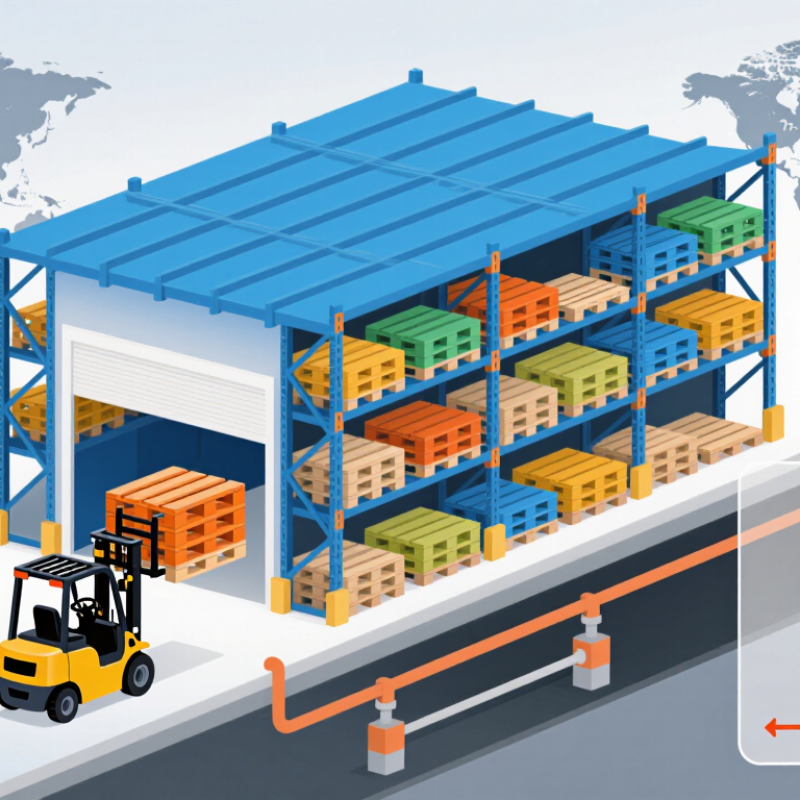
Drive-in storage is a high-density pallet racking system designed for similar goods stored in large quantities. Unlike selective racking, it removes many aisles and uses warehouse space more efficiently. A forklift enters the rack structure, travels along support rails, and places pallets from the back toward the front. The same forklift later retrieves them through the entry point.
This system normally follows the last-in, first-out method. The newest pallet is removed first. Each lane may hold several pallets at different depths, while upright frames and guide rails support the load. For example, a cold-storage warehouse may use drive-in racks for frozen food with limited product variety. Forklift speed must remain controlled. Small steering errors can damage rails or pallet edges.
Global buyers should check pallet dimensions, load weight, forklift clearance, floor capacity, and local safety requirements. Climate also matters. Humid sites may need stronger corrosion protection, while seismic regions require engineered anchoring and structural review. In warehouse assessments, poor pallet quality often causes more trouble than the rack itself. Bent boards, uneven loads, or incorrect entry angles can reduce safety and storage efficiency. It is not perfect. Drive-in storage saves space, but it offers less direct access to individual pallets and demands disciplined stock rotation.
| Evaluation Dimension | Typical Data or Range | What It Means | Selection Guidance for Global Buyers |
|---|---|---|---|
| Storage Principle | Forklift enters the rack structure and places pallets on continuous support rails. | The system removes most aisle space and stores pallets in deep lanes. | Choose it when maximum floor-space utilization is more important than direct access to every pallet. |
| Inventory Rotation | LIFO: Last In, First Out | The pallet loaded last is normally retrieved first from the same lane. | Suitable for products without strict first-expiry requirements, such as seasonal or non-perishable goods. |
| Best Product Profile | Uniform pallets; limited stock-keeping units; high quantities per SKU. | Standardized loads can share the same lane efficiently. | Avoid using deep lanes for highly mixed inventories with frequent item-by-item picking. |
| Pallet Load Capacity | Common design ranges are approximately 500–1,500 kg per pallet position; project-specific designs may be higher. | The required capacity depends on pallet weight, load distribution, beam span, and safety factors. | Confirm the maximum gross pallet weight and point-load requirements before ordering. |
| Pallet Dimensions | Common reference footprints include 1,200 × 800 mm and 1,200 × 1,000 mm. | Pallet size affects rail spacing, lane width, clearances, and usable storage depth. | Use local pallet standards and allow clearance for pallet deflection and forklift operation. |
| Storage Density | Often higher than selective pallet racking because each lane eliminates most intermediate aisles. | The exact improvement depends on building columns, fire aisles, lane depth, ceiling height, and handling equipment. | Compare usable pallet positions per square metre, not only the rack footprint. |
| Recommended Lane Depth | Common applications use several pallets in depth; the practical limit is determined by access frequency and forklift reach. | Deeper lanes improve density but make individual pallet access less convenient. | Select lane depth according to stock volume, replenishment frequency, and expected dwell time. |
| Forklift Compatibility | Drive-in forklifts require suitable lift height, mast clearance, turning radius, and aisle width. | The rack must accommodate the actual truck, pallet, operator visibility, and operating method. | Submit the forklift model, load centre, dimensions, and lift height during the design stage. |
| Clearance Requirements | Required clearances vary with pallet size, load overhang, rail geometry, and local safety rules. | Insufficient clearance can cause pallet damage, rack impact, and unsafe forklift movement. | Request a dimensional layout showing upright spacing, rail levels, lane width, and top clearance. |
| Rack Height | Determined by building clear height, pallet height, forklift lift height, roof services, and required safety clearances. | More vertical levels can increase capacity without increasing floor area. | Check sprinkler, lighting, seismic, and building-code constraints before maximizing height. |
| Loading Method | Typically loaded and unloaded from the same open face of a lane. | The structure is generally optimized for one-sided access and LIFO operation. | For FIFO flow, consider a drive-through arrangement only when the building and budget support two-sided access. |
| Structural Protection | Common protection measures include upright guards, guide rails, entry guides, and reinforced frames. | Protection reduces damage caused by forklift contact during entry and retrieval. | Prioritize protection at lane entrances and specify replaceable components where possible. |
| Environmental Conditions | Indoor, cold-storage, humid, corrosive, and seismic applications require different materials and calculations. | Temperature, moisture, corrosion, and seismic forces affect steel selection and structural design. | Provide the installation country, temperature range, humidity, corrosive exposure, and seismic design category. |
| Applicable Standards | Requirements may involve local building codes, fire regulations, seismic rules, and recognized rack design standards. | Compliance obligations differ by country and sometimes by region or facility type. | Have the final design reviewed against the installation location’s current regulations. |
| Operational Suitability | High suitability for bulk storage, seasonal inventory, cold rooms, and products with low picking frequency. | Drive-in storage prioritizes density and batch handling over rapid individual-pallet access. | Use selective or dynamic systems instead when SKU variety, FIFO, or frequent picking is the primary requirement. |
| Procurement Checklist | Required inputs: pallet size, pallet weight, quantity, lane depth, building height, forklift data, environment, and local regulations. | Complete information reduces redesign, installation delays, and compatibility risks. | Ask for layout drawings, load tables, installation instructions, inspection guidance, and warranty terms. |
Note: Capacity, dimensions, clearances, and compliance requirements must be verified through a project-specific structural design and the regulations applicable at the installation site.
Measure pallet length, load height, and weight. Record packaging type and inventory movement. Check forklift turning space carefully. Product temperature and humidity needs also matter.
Drive-in storage suits high-density inventory with few product types. It works well when many pallets share similar dimensions. It is less suitable for frequent access to individual pallets. Convenience may drop.
Start with actual pallet positions, not advertised volume. Measure clear height, rack depth, aisle width, and safety clearances. Include space for beams, sprinklers, lighting, and ventilation. A perfect cube rarely works.
Observe receiving times, loading frequency, and pallets entering each lane. A dense layout may slow every unloading cycle. Leave room for inspections, maintenance, and emergency movement. Drawings can hide practical problems.
Verify floor flatness and slab strength before installation. Small uneven areas can cause movement under heavy loads. Check dock height, entry depth, and forklift turning space. These details matter.
Frozen goods need controlled temperatures. Humid areas may affect equipment performance. Salt air can accelerate corrosion on unprotected steel. Consider coatings, drainage, and seasonal temperature changes.
Request load calculations, material specifications, installation tolerances, and inspection guidance. Confirm protection against forklift impacts. Ask how maintenance access will remain available. Price alone is not enough.
Compare access to ports, inland terminals, and major highways. Sea transport handles much global trade volume. Customs, infrastructure, tracking, and delivery timing also affect replenishment. A cheaper site may create delays.
Test forklift turning, rack entry, floor conditions, dock access, and emergency routes. Check whether vehicles can reach both building sides. Try a realistic unloading cycle. I may have underestimated this before.
Drive-in Storage is a high-density warehouse solution designed to maximize floor and cubic space by allowing forklifts to enter storage lanes and place pallets on supported rails. This system is especially suitable for facilities handling large quantities of similar products, but it requires careful planning. Buyers should first define pallet dimensions, load weights, inventory turnover, loading patterns, available ceiling height, floor conditions, and required temperature or environmental controls.
When comparing options, global buyers should evaluate capacity, lane depth, layout efficiency, forklift access, and inventory accessibility. Safety and long-term performance depend on strong structural design, impact protection, corrosion resistance, clear operating procedures, and compliance with applicable local standards. Supplier assessment should include manufacturing quality, engineering support, documentation, warranty terms, replacement parts, installation capability, and after-sales service. A complete cost review should cover equipment, shipping, taxes, installation, training, maintenance, and future expansion. Careful comparison helps buyers select a reliable Drive-in Storage system that balances density, safety, operational efficiency, and total ownership cost.

 Shibang Storage Rack